Reviews are the single biggest lever you've got on Google Maps, and they're the one most trades leave on the table. Not because asking is hard. Because asking at the wrong time, in the wrong way, kills the response rate before it starts. Sort the six things below and the reviews look after themselves.
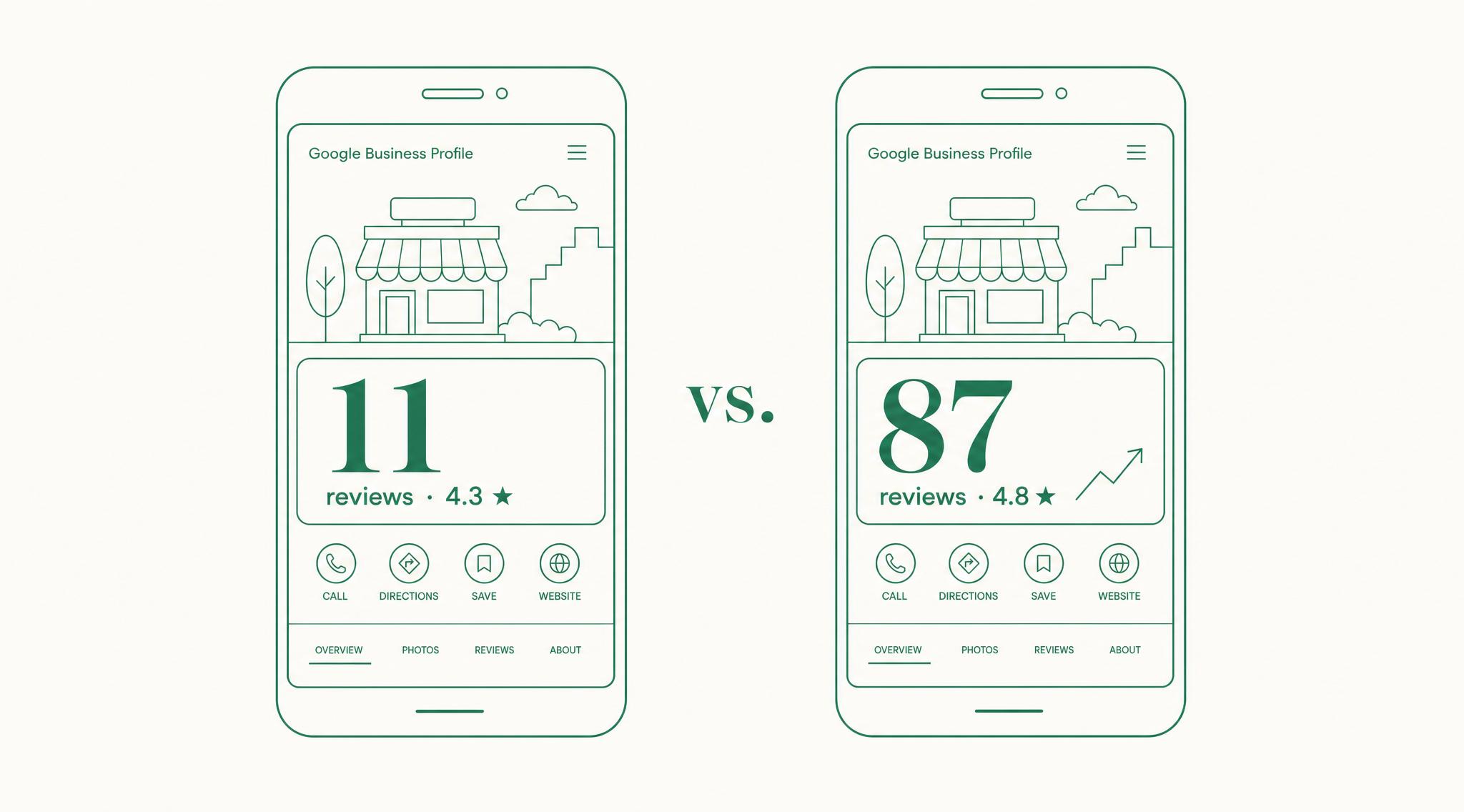
Here's why it's worth the bother. The number of reviews you have, and how recent they are, is one of the strongest signals Google uses to decide who sits in the top three for "plumber Naas" or "salon Cork". A profile with 87 recent reviews beats one with 11 old ones nearly every time, even if the work behind the 11 is better. Customers read it the same way: most won't ring a trade with a handful of reviews when the next one along has dozens. Reviews are both your ranking and your shop window.
1. Ask within four hours
The trick most lads miss is timing. Send the review link two to four hours after the job — when the customer's home with a cup of tea and the relief of a working boiler is still fresh. Ask the next morning and the moment's gone; ask a week later and you're a stranger. The window is tighter than you'd think, and it's the difference between a 40% response rate and a 5% one.
Why four hours and not straight away? Right after the job they're still paying you, finding the stopcock, getting the kids' tea on. Give it a few hours and they've had the relief of the thing being fixed, but it's still fresh. That's the sweet spot. If you do nothing else from this list, fix your timing.
2. Ask by text, not email
People read texts. They read them in minutes. Email asks land in a pile that gets opened on a Sunday, if at all — open rates on review-request emails sit in the low single digits, while a text gets read almost every time. A short SMS, or WhatsApp, gets the click while the job's still in their head.
WhatsApp is worth a special mention in Ireland: roughly 60% of customers here prefer it over a plain text, and a message there feels personal rather than automated. The big US review tools don't do native WhatsApp at all, which is one of the quiet reasons they underperform on this side of the water.
3. Make one ask, not three
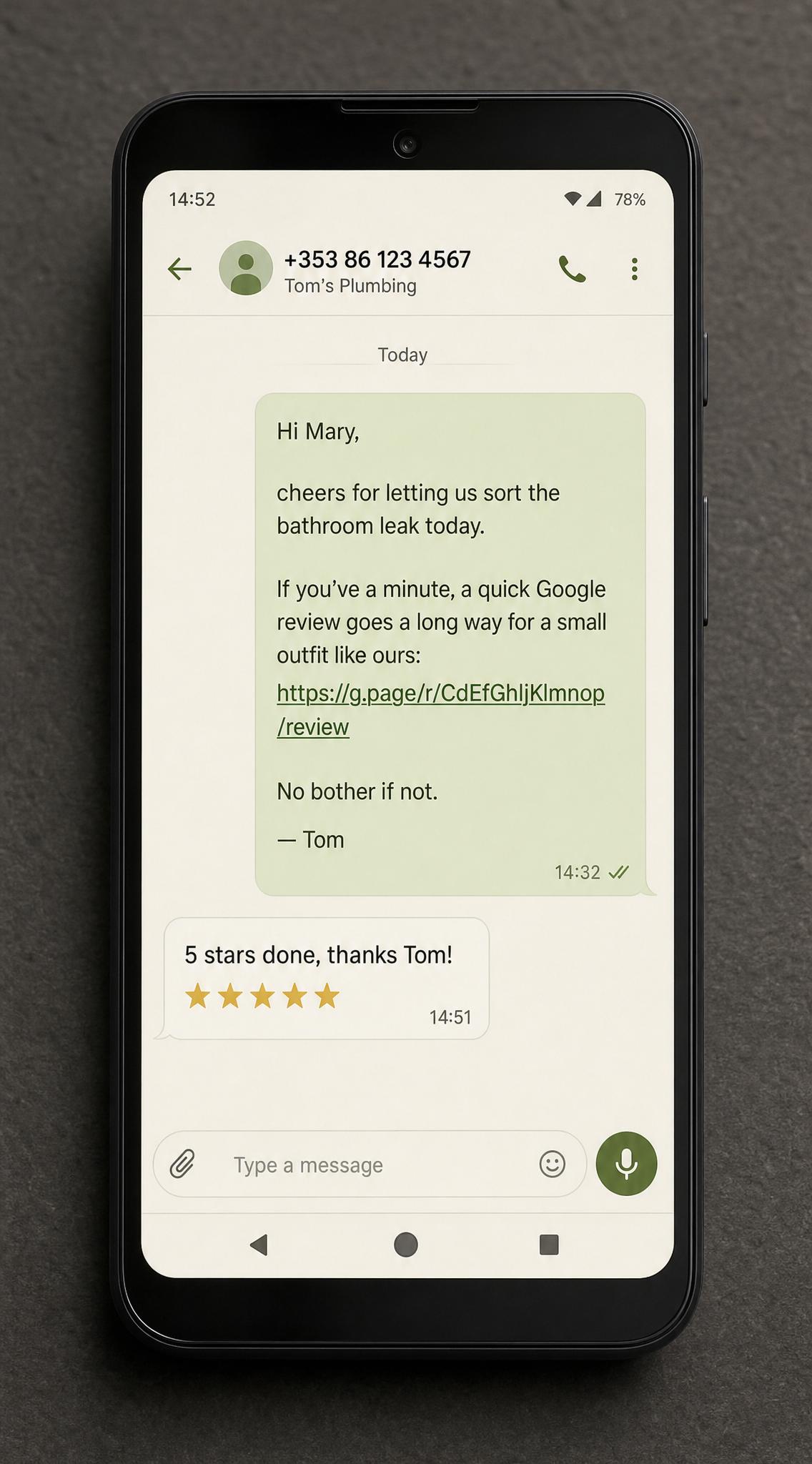
Don't bundle. "Thanks, here's your invoice, can you review us, and follow us on Facebook" gets you nothing — every extra ask halves the odds of any of them happening. One sentence, one link, one ask. The publican rule applies: say the thing, then stop talking.
Keep it human, too. A line that reads like a form letter gets ignored. A line that reads like you, the person who just did the job, gets a tap.
"Hi Mary, cheers for letting us sort the leak today. If you've a minute, a quick Google review goes a long way for a small outfit like ours: [link]. No bother if not."
4. Send the direct review link
Never make a customer search for you and scroll for the review box. Google gives every profile a short review link that opens straight to the stars — you'll find it in your Business Profile under "Ask for reviews", or by tapping "Get more reviews" on the profile dashboard. Paste that exact link into every message. Every extra tap between the customer and the stars costs you reviews.
A quick test: open your own link on your phone. If it lands you on the five-star box in one tap, grand. If it makes you hunt, fix it before you send another request.
5. One nudge, then leave it
If they forget, one gentle reminder a few days later does the job. After that, stop. Chasing a third time annoys good customers and tires your book. The maths works because you're asking every customer once — politely, well-timed — not because you're asking a few customers five times.
And ask everyone, not just the ones you think loved it. The customer who seemed quiet often leaves the best review. The one who gushed on the day sometimes never gets round to it. You can't pick the winners, so ask the lot.
6. Reply to every single one
Reply to all of them — the five-stars with a quick cheers, the rough ones calmly and offline. Google reads engagement, so a replied-to profile ranks better than a silent one. And the next customer reads how you handle feedback before they decide to ring you. A calm, owner-signed reply to a bad review reassures the reader far more than the review worried them.
Two rules for the rough ones: never argue, and never name names or job details. Acknowledge it, apologise if it's warranted, and move it to a phone call or email. "Sorry that didn't land right, John — drop me a line and I'll sort it" does more good than a paragraph defending yourself in public.
Ask every customer, within four hours, by text, with one ask. A plumber doing 15 jobs a week at a 30% response rate adds roughly 18 reviews a month. That's how 11 becomes 87 by Christmas.
The mistakes that quietly kill your response rate
Even trades who ask regularly often bleed reviews through a few avoidable habits. Watch for these:
- Asking in person and hoping. "Sure, leave us a review" at the door feels productive, but almost nobody does it from memory. Send the link.
- Sending a QR code on the invoice. Invoices get filed, not scanned. The review ask needs to be its own message, not a footnote on a PDF.
- Linking to your homepage. If the link lands on your website instead of the Google review box, you've added three taps and lost most people.
- Only asking the happy-looking ones. You're a poor judge of who'll actually write one, and cherry-picking skews your profile. Ask everyone.
- Going quiet for months, then blasting your whole book at once. A sudden flood of reviews after a long silence looks unnatural to Google. A steady trickle, every week, is what you want.
Can I offer a discount for a review?
No — and it's worth being clear on this, because it catches people out. Google's policy bans incentivised reviews: you can't offer money, a discount, a free service, or entry to a prize draw in exchange for a review. You also can't "gate" them — that is, only sending the review link to customers who tell you privately they were happy. Both can get your reviews stripped or your profile flagged.
What you can do is ask everyone, plainly, every time. The whole point of good timing and a clean ask is that you don't need to bribe anyone. A customer whose leak you sorted that afternoon is glad to leave two lines if you make it a single tap.
How many reviews do you actually need?
There's no magic number, because it's relative — you need a few more than the businesses you're competing with in the local pack for your main keyword. In a quiet rural town that might be 20. In a Dublin suburb where everyone's at it, it might be 150. The honest way to find your target is to search your main keyword, look at who's sitting in the top three, and note their review counts. That's your bar. Recency matters as much as the total, so a steady flow beats a one-off push every time.
A worked example
Take a one-van plumber in Naas doing 15 jobs a week. Today he's on 11 reviews and asks now and again, by email, when he remembers — maybe one review a month. Switch to the playbook: every customer texted at the three-hour mark with the direct link. At a 30% response rate that's about 4 to 5 reviews a week, call it 18 a month. Six months on he's past 90, replying to each one, and he's climbed from the bottom of the second page into the local pack. Nothing about his work changed. Only the asking did.
Why this beats buying reviews or chasing other platforms
Two shortcuts tempt people and both backfire. The first is buying reviews or running a "review gate" — it's against Google's rules, and a sudden batch of suspiciously positive five-stars is exactly what gets a profile flagged or stripped. Earned reviews, coming in steadily from real jobs, are the only ones that hold. The second is spreading yourself thin across Facebook, Trustpilot, Yelp and the rest. For a local trade, Google is where the searching happens — get that one right before you worry about anywhere else. A focused profile with 80 recent Google reviews does more for you than a handful scattered across five platforms.
The catch
All six steps are simple. None of them are hard. The reason most trades still sit on 11 reviews is that doing this by hand, after every job, forever, is the thing that never happens. You finish the job, you're on to the next one, and the text never gets sent. The playbook isn't the hard part — the consistency is.
That's the one job worth handing off. A Google Business Profile autopilot sends the text on the four-hour timer, drafts your replies for one-tap approval, and keeps the whole thing running whether or not you remember it. The playbook above is what it does, on rails, after every job.
When is the best time to ask for a review?
Two to four hours after the job. The customer's had the relief of it being sorted, but it's still fresh. Ask the next day or a week later and the response rate falls off a cliff.
Text or email?
Text or WhatsApp. Texts get read in minutes; review-request emails sit unopened. In Ireland around 60% of customers prefer WhatsApp, and the US tools don't do it natively.
Can I offer a discount for a review?
No. Google bans incentivised reviews — no money, discounts, free work, or prize draws — and you can't only send the link to customers who privately say they're happy. Ask everyone, plainly. Good timing means you don't need to bribe anyone.
How many reviews do I need?
A few more than whoever's ranking above you for your main keyword. Search it, look at the top three, note their counts — that's your bar. A steady weekly trickle beats a one-off flood.