Most trade-shop owners know their Google profile matters. They also know they never get round to it. A Google Business Profile autopilot is the answer to that gap — a tool that does the four repeating jobs in the background, so the work happens whether or not you remember.
If you've ever looked at the lad two streets over sitting on 87 reviews while you're stuck on 11, this is the article for you. He isn't better at the job. He set something up that asks for the reviews, replies to them, keeps his profile fresh, and watches where he ranks. You've been doing it by hand, when you remember, which is to say almost never. That's the whole gap, and it's the gap an autopilot closes.
First, what a Google Business Profile actually is
Your Google Business Profile is the listing that shows up when someone searches your trade and your town — "plumber Naas", "barber Galway", "dentist Cork". It's the box on the right with your stars, your hours, your photos, and the little map pin. For a local trade it's the most valuable square of screen on the internet, because the person looking at it is ready to ring someone today. They're not browsing. They've a burst pipe.
Google decides whose profile sits in the top three — the "local pack" — using a mix of signals: how many reviews you have and how recent they are, whether you reply to them, how often you post, whether your name and address match across the web, and how close you are to the searcher. Get those right and you climb. Ignore them and you drift, no matter how good your work is.
The four jobs it does
An autopilot isn't one feature. It's a stack of four that, done together, keep your profile pulling its weight:
- Chases reviews. It texts every customer a few hours after the job — when they're home, not when the radiator's still being bled — and asks for a Google review in your voice.
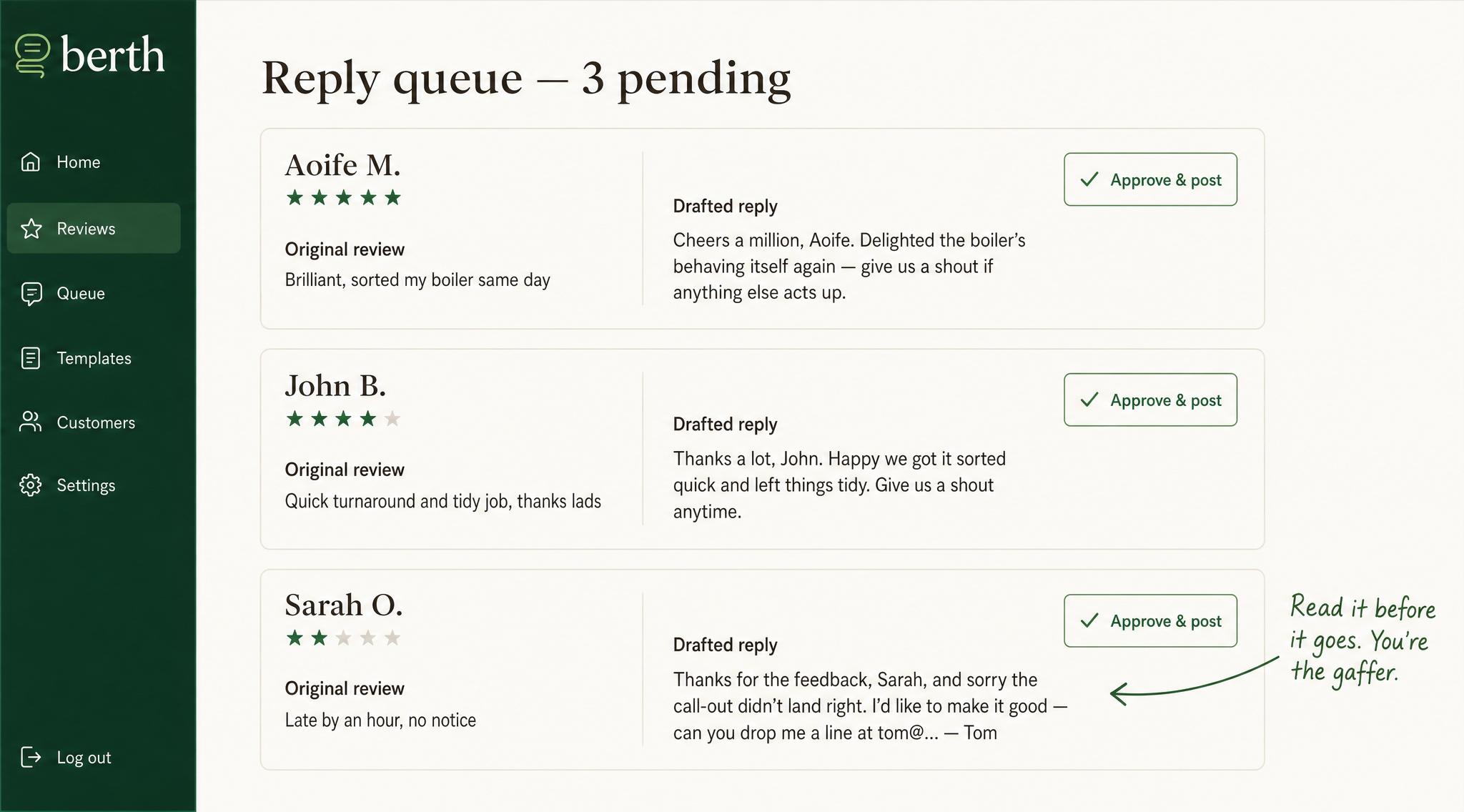
- Drafts replies. Every review gets a reply written the way you'd write it. You approve in one tap. The awkward ones wait for you.
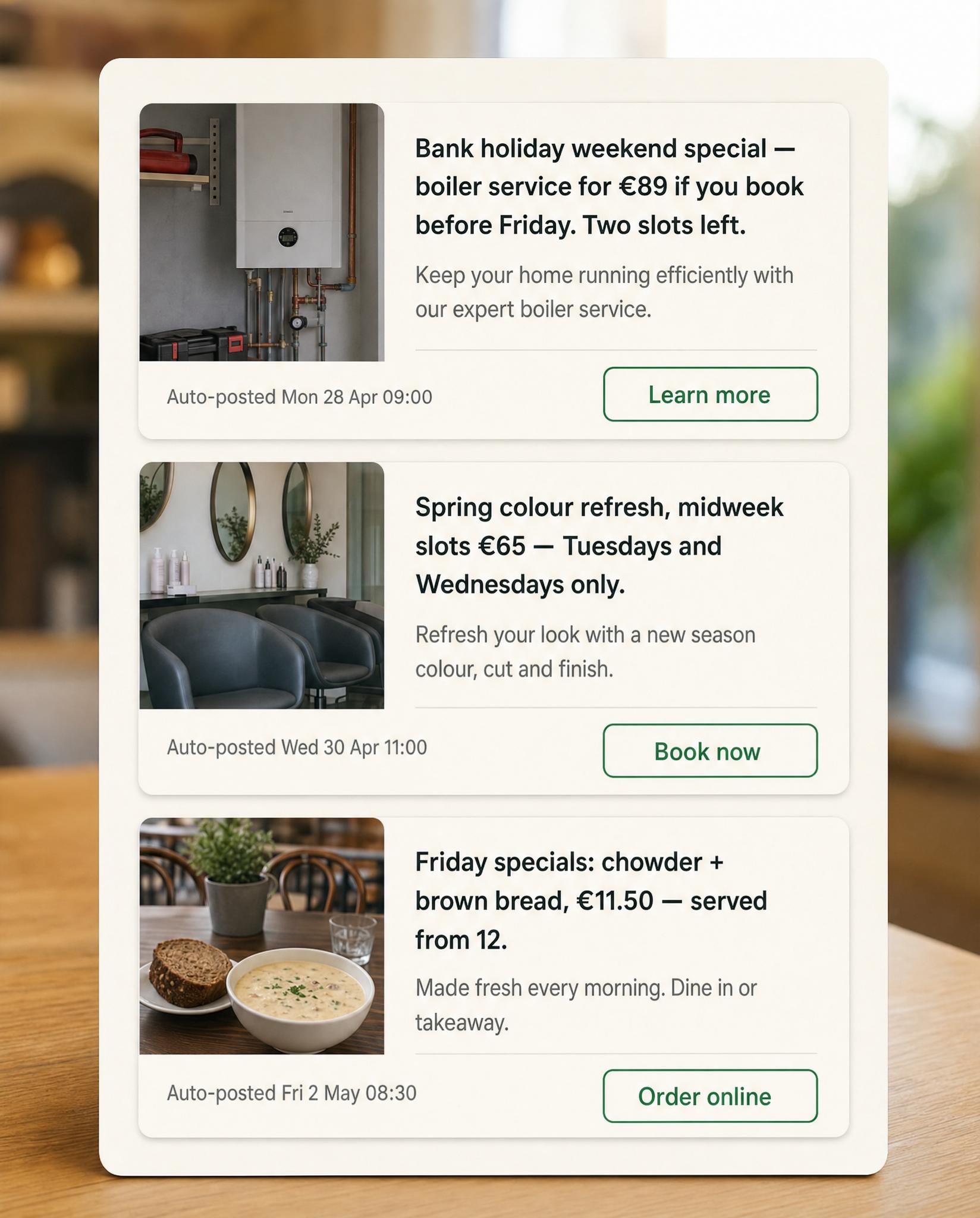
- Posts weekly. Two or three posts a week to your profile — offers, hours, a fresh photo — so it reads like a real shop, not a dormant listing.
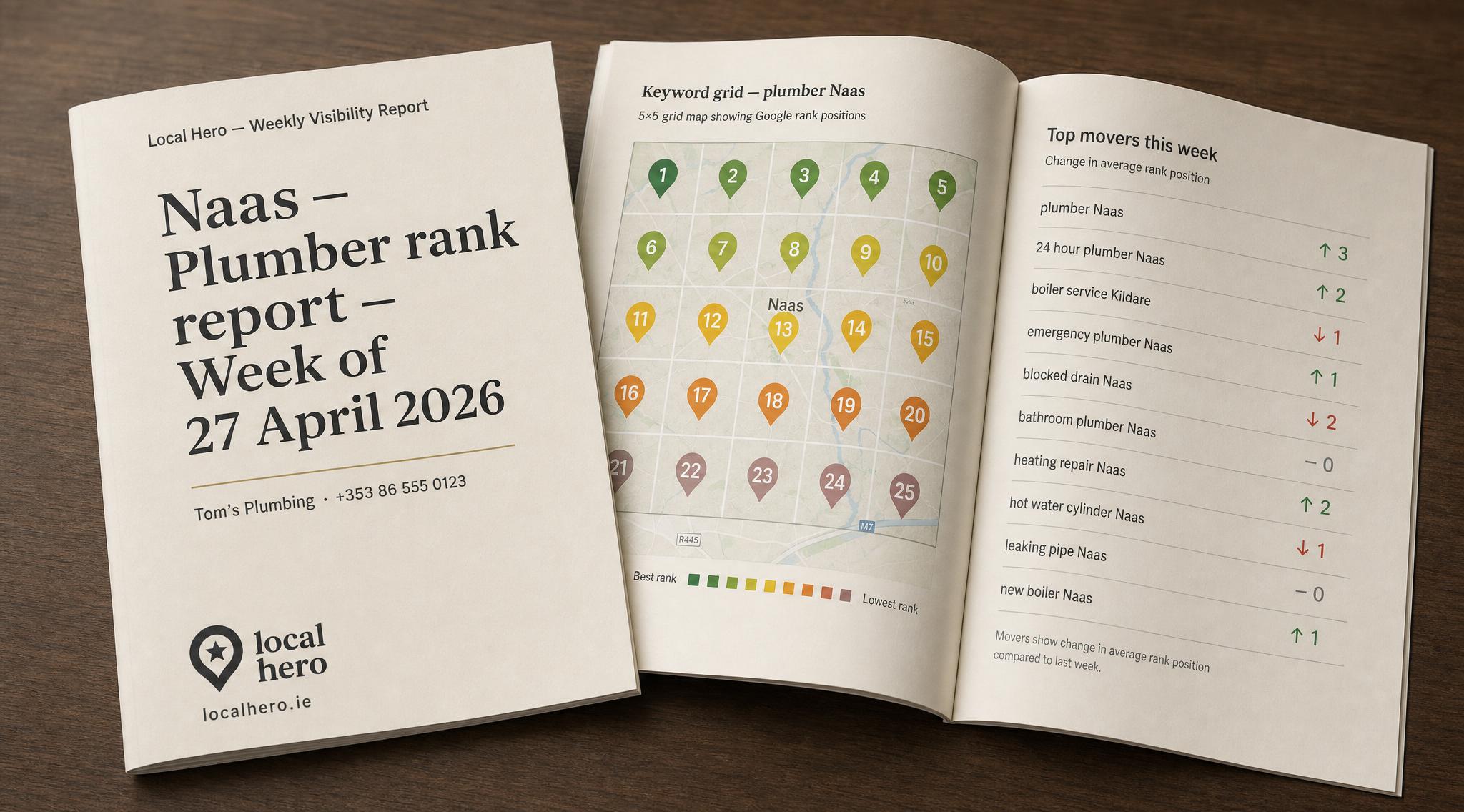
- Tracks your rank. Every week it checks where you sit on Google Maps for your main keywords in your town, and tells you in one page.
1. Chasing reviews — the timing job
Reviews are the single biggest lever on local rank, and the one most trades leave on the table. Not because asking is hard, but because asking at the right moment never happens when you're on to the next job. An autopilot sends the request on a timer — two to four hours after the job's marked done, by text, with one ask and the direct review link. That timing is the difference between a 40% response rate and a 5% one.
2. Drafting replies — the awkward job
Google reads engagement, so a profile where every review gets a reply outranks a silent one. But writing replies after a long day is the job that slides. An autopilot drafts each one in your voice — a quick cheers for the five-stars, a calm owner-signed line for the rough ones — and you approve in a tap. One- and two-star reviews are never auto-posted. They always wait for you, because a bad reply to a bad review does more damage than the review itself.
3. Posting weekly — the freshness job
A profile that hasn't posted since last summer looks shut. Google treats fresh posts as a sign the business is active, and active profiles rank better. Two or three short posts a week — an offer, your bank-holiday hours, a photo of a finished job — keep it looking alive. An autopilot drafts them and queues them, calibrated to the things that actually matter locally, like Irish bank holidays and a week of UK rain.
4. Tracking rank — the honesty job
"Are we doing better?" is the question, and most tools answer it with a 40-page report nobody reads. An autopilot runs a grid around your address each week for your main keywords and tells you in one page: green where you're ranking, amber where you nearly are, red where you're not. Knowing you're number one in Sallins but eleventh in Newbridge is the kind of answer you can act on.
Review software does one job. An autopilot does the four that actually move local rank — and keeps any of them from landing back on your desk.
Why "autopilot" and not "review tool"
The US tools — Birdeye at $299 a month, Podium at $249, NiceJob at $75 to $125 — grew up as review platforms. Reviews are one job. The trouble is, reviews on their own don't hold a local ranking. Google reads the whole picture: fresh posts, replied-to reviews, consistent details across directories, recent photos. A tool that only chases reviews leaves three of the four signals untended.
An autopilot is named for what it removes, not what it adds. The win isn't a dashboard with more buttons. It's that you stop being the person who has to remember to ask for the review, write the reply, and post on a Wednesday. The plane holds its line while you do the job you actually do. That's the shift in the word: from a tool you operate to a system that runs.
There's a second reason the US tools don't fit an Irish or UK trade. They bill in dollars, they don't do native WhatsApp — which 60% of Irish customers prefer over a text — and they write in a voice that sounds nothing like the way you'd talk to a customer in Naas or Newcastle. An autopilot built for this side of the water asks in Hiberno-English by default, takes WhatsApp, and bills in euro or sterling. Small things, but they're the difference between a customer clicking the link and ignoring it.
What it doesn't do
Honesty matters here. An autopilot won't rebuild your website, run your ads, or promise you'll hit number one — nobody honest can promise that. It won't auto-post a reply to a one-star review. It won't invent reviews, and you wouldn't want it to: fake reviews are against Google's rules and a fast way to get a profile suspended. What it does is the legitimate, repeating work that earns real reviews and keeps your profile in good standing.
It's the difference between hiring a marketing agency for €1,500 a month and running the repeatable bit yourself for €29. The agency adds strategy, ad spend, and a person to sit in a meeting with you. The autopilot does the four jobs that repeat every week, for a fraction of the cost. Plenty of single-location trades only ever need the second one. If you want the full breakdown, we wrote a separate piece on whether €29 a month is enough to manage a profile.
Who it's for
If your customers find you on Google Maps, an autopilot earns its keep — plumbers, sparks, salons, dentists, gyms, cafés, mobile mechanics, cleaners, accountants. Anyone who lives or dies by the local pack and hasn't the hours to work it by hand. The trades who get the most out of it are the ones who do good work and know it, but watch a noisier competitor outrank them purely because that competitor's profile is busier.

How to tell if you need one
A quick gut check. If three or more of these are true, an autopilot will pay for itself fast:
- You've fewer reviews than the business you most want to outrank.
- Your last review came in more than a month ago.
- There are reviews on your profile you've never replied to.
- You haven't posted to your profile this year.
- You couldn't say, right now, where you rank for your main keyword in your town.
None of those are failings. They're just the jobs that never make it to the top of the list when you're running a trade single-handed. That's exactly the work worth handing to something that doesn't forget.
What setting one up actually involves
People assume "autopilot" means a long, technical setup. It doesn't. The one-time part is connecting your Google Business Profile, telling it how you talk so the replies sound like you, and pointing it at your main keywords and the area you serve. That's the bones of it — call it half an hour, most of which is you reading sample replies and saying "yes, that's how I'd put it" or tweaking a word.
After that, the day-to-day is light by design. A job gets marked done, the review request goes out a few hours later, and when reviews land you get a quick prompt to approve the drafted replies. A short nudge once a week to post a photo. A one-page rank report on a Monday. The whole point is that it asks you for a tap here and there, not a Tuesday afternoon. If a week goes by where you do nothing, the asking, replying, and posting still happened.
The bottom line
A Google Business Profile autopilot is the quiet system that keeps your most valuable listing working while you're on the tools. Four jobs — reviews, replies, posts, rank — done on a timer, in your voice, with you approving the bits that need approving. It won't replace good work or word of mouth. It makes sure the people searching for your trade in your town actually find you first. For most local businesses, that's the whole game.
What is a Google Business Profile autopilot?
A tool that runs four repeating jobs for you: asks every customer for a review, drafts replies in your voice, posts to your profile weekly, and tracks where you rank in your town. You approve what needs approving; the rest runs in the background.
How is it different from review software?
Review software chases reviews and stops there. An autopilot does the full stack — reviews, replies, weekly posts, rank tracking — so no single task lands back on your Tuesday afternoon.
Do I lose control of my replies?
No. Replies are drafted in your voice and you approve them in one tap. One- and two-star reviews never auto-post.
What does it cost?
Local Hero is €29 a month. Agencies charge €1,000 to €2,000 for broadly the same repeating jobs, plus strategy work an autopilot doesn't try to do.