The short answer: for most single-location trades, yes. The longer answer is worth four minutes, because "enough" depends on what you actually need doing — and a lot of what agencies bill for, you don't.
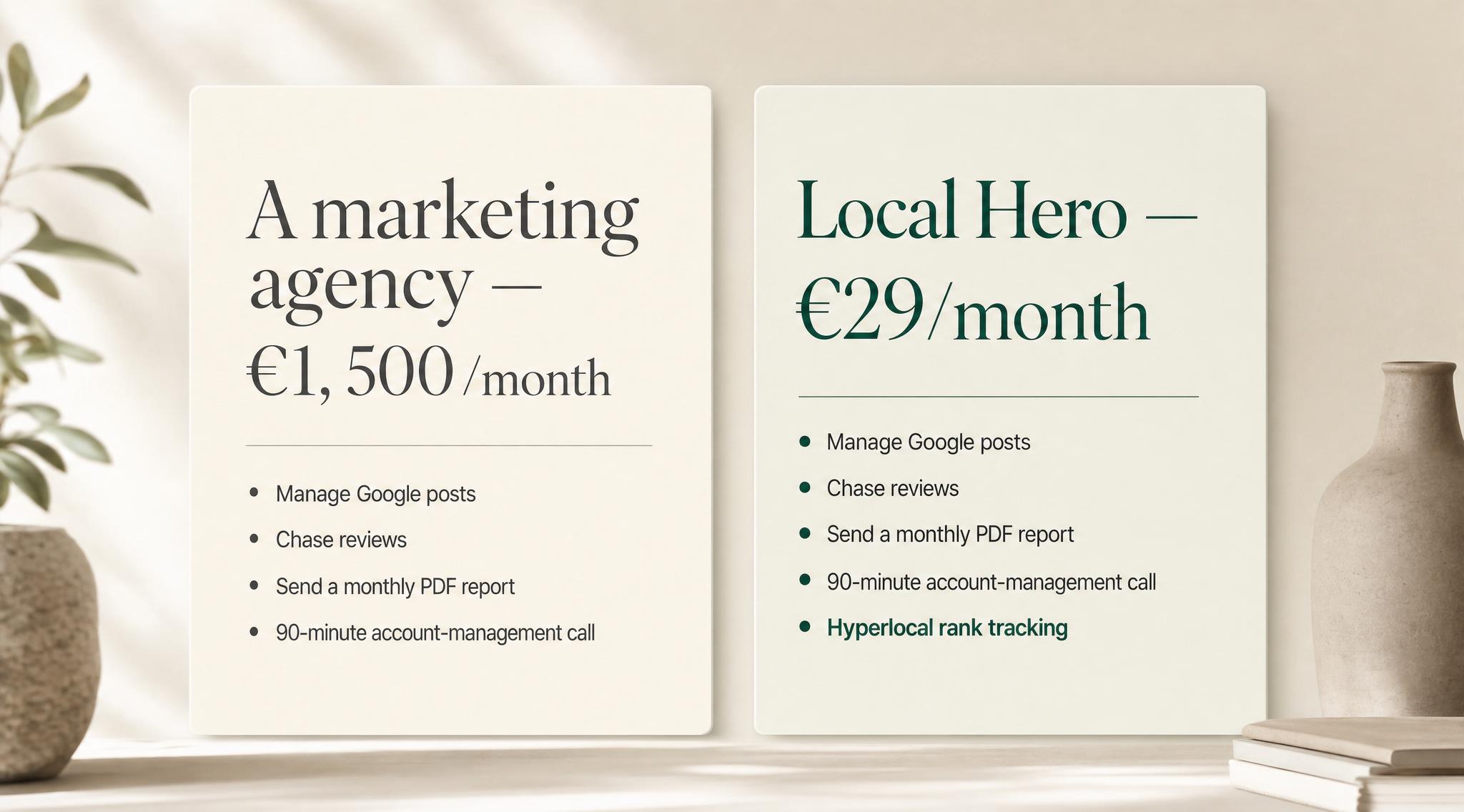
The reason €29 raises an eyebrow is that we've all been trained to expect a bigger number. A marketing agency quotes €1,000 to €2,000 a month and the figure feels serious, so it must be doing something serious. But a lot of that retainer is the agency's overhead — account managers, meetings, a slide deck every quarter — not work that moves your Google ranking. Strip it back to the jobs that actually change where you appear on the map, and the price drops a long way.
What €29 buys
At €29 a month you get the four jobs that repeat every week and actually hold a local ranking:
- Every customer asked for a review, by text, on the right timer.
- Every review replied to in your voice, with one-tap approval.
- Two or three posts a week to your profile.
- A weekly rank report showing where you sit in your town.
Those four, done consistently, are most of what moves a trade up the local pack. Not strategy decks. Not a logo refresh. The repeating work — the stuff that, done every week without fail, quietly compounds into more reviews, a fresher profile, and a higher spot on the map.
What it doesn't buy
Honesty matters here, so plainly: €29 doesn't get you a marketing strategy, ad management, a new website, or someone to sit in a meeting with you. It won't promise a number-one ranking, because nobody honest can. It isn't an SEO consultant who'll study your competitors and rebuild your site. If those are the things you need, an agency is the right call and the €1,500 is fair money for real work.
What €29 won't ever do is cut corners on the legitimate side — no bought reviews, no fake engagement, nothing that puts your profile at risk of suspension. Cheap doesn't mean dodgy. It means narrow: it does the four repeating jobs properly and leaves the strategy to you or to an agency, if you want one.
An agency sells you strategy plus the repeating work, bundled. The €29 tier sells you the repeating work, on its own. Most trades only ever needed the second half.
The maths
€29 a month is €348 a year. For a plumber, a single boiler job covers the year. For a salon, a few new regulars. For a dentist, less than one new patient. The cost is fixed and small; the upside is every customer who rings because your profile finally climbed past the lad two streets over.
Compare that to €1,500 a month — €18,000 a year — and the question flips. It's not "is €29 enough?" It's "do I need to spend fifty times that to get the four jobs done?" For most local trades, the answer is no. The agency's extra €17,652 buys strategy and hand-holding, which is worth it for some and pure overhead for others.
Run it the other way and the floor is low. If the autopilot wins you one extra job a month that you'd otherwise have lost to a higher-ranked competitor, it's paid for itself several times over. For a trade where one job is worth a few hundred euro, that's not a hard bar to clear.
Where the €29 number comes from
It isn't a loss-leader or a trial price that doubles in three months. The four jobs are largely automated — the asking, drafting, posting, and rank-checking run on software, not on someone's billable hours. That's the whole reason the price can be what it is. The US incumbents charge $249 or $299 because they're built for enterprise sales teams and priced for American mid-market budgets, not a one-van plumber in Kildare. Strip out the sales overhead and build it for trades, and €29 covers it with room to spare.
The alternative isn't free — it's your time
There's a third option people forget: doing it yourself for nothing. Except it isn't nothing. Done properly, the four jobs are maybe three to four hours a week — texting every customer at the right moment, drafting and posting replies, writing two or three profile posts, and running a rank check. Put your own hourly rate against that and "free" gets expensive fast. A plumber who charges €60 an hour is spending the guts of €200 a week in time, or would be, if the work actually got done.
And that's the real catch with the DIY route: it doesn't get done. Not because you're lazy — because you're busy doing the work that pays. The text never gets sent, the review sits unanswered, the profile goes quiet. €29 a month isn't really competing with free. It's competing with the version of this that never happens.
How €29 compares to the US tools
If you've shopped around, you'll have seen the names. Birdeye sits around $299 a month. Podium is roughly $249. NiceJob runs $75 to $125. Merchynt is about $179. They're capable tools, but three things make them a poor fit for an Irish or UK trade: they bill in dollars, they're priced for American mid-market companies with a marketing person on staff, and they don't do native WhatsApp, which is how a lot of your customers actually want to be contacted. You'd be paying enterprise money for a tool that speaks the wrong language to your customer book.
A tool built for this market — euro or sterling billing, Hiberno-English by default, WhatsApp as a first option — does the same four jobs without the import tax. That's the gap €29 fills: not "cheaper for the sake of it", but priced and built for a single-van trade rather than a US sales floor. We lay it out tool by tool in the comparison pages if you want the detail.
No contract, which matters
A €29 monthly plan you can cancel any time is a different proposition to a €1,500 retainer with a notice period. The risk to you is one month, not a year. That's the right shape for trying something: if it doesn't earn its keep in the first few weeks of reviews and rank movement, you stop, and you're out the price of a tank of diesel. The low number isn't just easy on the wallet — it's easy to walk away from, which is exactly why it's easy to start.
When €29 isn't enough
There are real cases where you should spend more. You're running paid ads at scale and need someone managing the budget daily. You've got five locations and need them coordinated. You're in a brutally competitive city-centre category where everyone's already doing the basics well. You want a full rebrand or a new website. Those need a person and a budget, and no €29 tool pretends otherwise.
But if you're a single-van trade or a one-room salon who just wants the Google bit handled — reviews coming in, replies going out, profile kept fresh, rank tracked — €29 does the job that matters, and does it every week without you lifting a finger.
A worked example: a salon in Galway
Say a two-chair salon in Galway is sitting outside the local pack for "hairdresser Galway". They're good, they're busy enough, but they're invisible on the map next to a salon up the road with three times the reviews. They sign up at €29. Over the next quarter the autopilot texts every client a couple of hours after their appointment, replies to each review that lands, posts a couple of times a week, and sends a Monday rank report.
Three months in, they've gone from 14 reviews to 70-odd, all replied to, and they've moved into the top three for their main keyword. The cost so far is €87. One new regular client — a colour every six weeks — covers more than a year of the subscription on their own. The maths isn't close. And nothing about the salon's actual work changed; the only thing that changed was that the asking finally happened, every time, without anyone having to remember.
The objections, answered straight
"It's too cheap to be any good." Cheap-for-trades, not cheap-because-it-cuts-corners. The jobs are automated, so the price reflects software doing the repetitive work, not a junior at an agency doing it by the hour. The output is the same legitimate review-chasing and posting you'd do yourself, just done reliably.
"I tried a tool before and it didn't work." Usually that's a US tool that texted your customers in an American voice, didn't do WhatsApp, and billed in dollars — so the response rate was poor and you cancelled. The fix is timing, channel, and voice, which is exactly what a tool built for this market gets right.
"I don't have time to set it up." Half an hour, once. After that it asks for the odd tap, not your afternoons. If you've half an hour to read this article, you've half an hour to set it up.
So, is it enough?
For the great majority of local trades and service businesses: yes. €29 a month buys the four repeating jobs that hold a local ranking, done consistently, which is exactly the thing most owners never get round to doing themselves. It's not a replacement for a marketing strategy — it's a replacement for the strategy you were never going to write and the reviews you were never going to chase.
Want the full side-by-side? Read Local Hero vs a marketing agency, or start with what a Google Business Profile autopilot actually does.
Is €29 a month enough to manage a Google Business Profile?
For most single-location trades, yes. It covers the four repeating jobs — review chasing, reply drafting, weekly posts, and rank tracking — that hold a local ranking. It doesn't replace a full marketing strategy, but most single-van trades don't need one.
What does a €1,500 agency do that €29 doesn't?
Strategy, ad management, website work, and a named person to ring. If you need those, pay for them. If you mainly need the four repeating local-SEO jobs done consistently, that's what the €29 tier is for.
Can't I just do this myself for free?
You can, but it's three to four hours a week — and in practice it rarely gets done, because you're busy doing the work that pays. €29 competes with the version of this that never happens, not with free.
Is there a contract?
No. It's a monthly plan you can cancel any time, so your risk is one month, not a year-long retainer with a notice period.